

— expert picks and buying tipsEvery lash technician has been there: you are three hours into a volume set with your lash tweezers, your fans keep collapsing or refusing to splay evenly, and you find yourself questioning your entire technique. Then a colleague picks up the same extensions with a different tweezer and fans them perfectly in seconds. The tool was the variable, not the skill. Many technicians report this is a far more common variable than they are told during training, and it costs them time, confidence, and client results.
Choosing the right lash tweezers is one of the highest-impact decisions you will make as a professional, yet many buyers still default to price or visual appeal when placing an order. This guide cuts through that approach. You will find a clear breakdown of tip shapes and what each is actually engineered to do, an honest look at steel grades and coatings, a practical toolkit framework by service type, and a realistic view of where to source professional-grade tools in Pakistan, including how CFC Beauty Tools supports wholesale buyers and salons who want verified quality at trade pricing.
What each tweezer tip shape is actually designed to do
Tip shape is not a cosmetic feature. It determines your working angle, how much of the lash line you can see during application, and the type of grip you can achieve with each hand movement. Getting this wrong means fighting your tool on every appointment. Understanding it means your technique has the mechanical support it needs to deliver consistent results.
Straight and isolation-focused designs
Straight tweezers are the standard for isolation work in classic lashing. The upright, direct angle allows you to separate a single natural lash cleanly without disturbing the ones immediately beside it. The narrow tip and rigid control they offer make them the most reliable option for one-to-one classic application, where precision on the natural lash matters more than fan construction. If you are building a starter kit, a straight isolation tweezer belongs in it.
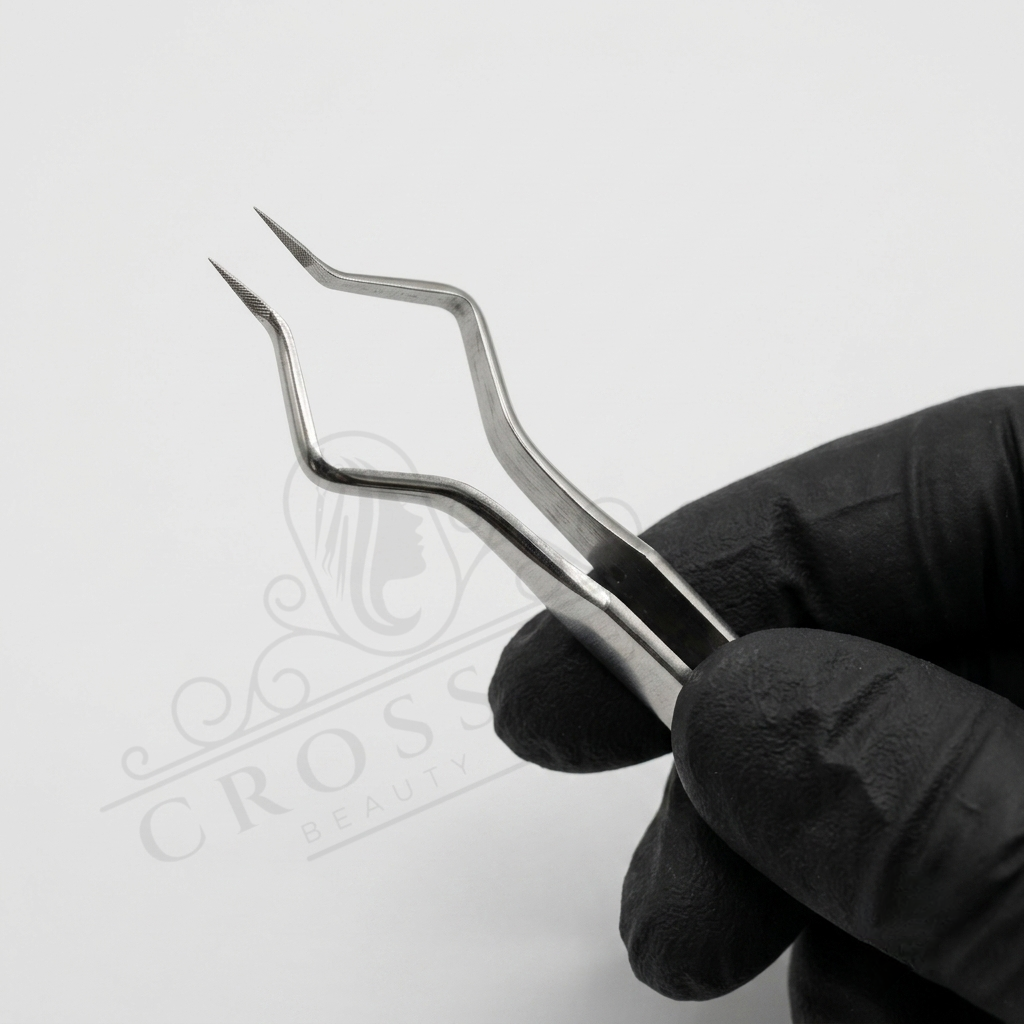
Curved and 45-degree tweezers
A curved tweezer shifts your wrist into a more ergonomic position, which directly reduces fatigue during long sets. For technicians who work heavy booking schedules, this is not a minor benefit. The 45-degree tweezer sits between a straight and a sharply angled design, giving you genuine versatility: it handles classic pickup, light volume fan creation, and corner access with equal competence. This combination is why 45-degree models are commonly the first tweezer recommended to students in training programmes, they do not require you to commit to a single technique or working style from day one.
90-degree and boot-style tweezers for volume and mega-volume
The sharp right-angle or L-shaped tip of a 90-degree tweezer creates a strong pinching surface built specifically for volume and mega-volume fan construction. When you are working with the pinching method, this geometry gives you the most consistent, narrow-base fans, particularly when handling ultra-fine extensions in the 0.03 mm range. For mega-volume sets, L-shaped and V-shaped designs are both recognised professional standards: the V-shape helps you grab multiple fine lashes simultaneously and build wider, denser fans without losing control of the base.
Steel grades, coatings, and why material is not a detail to skip
Most tweezers look similar in product photographs. The difference between a tool that degrades relatively quickly and one that stays precise for considerably longer lies in the steel grade and surface treatment. These are the specifications that buyers rarely ask about, and suppliers rarely volunteer unless they have something worth mentioning.
Japanese and medical-grade stainless steel: what the labels mean
Medical-grade or surgical-grade stainless steel is selected for its rust resistance, its ability to tolerate repeated sterilisation without degrading, and its stable tip alignment over repeated use. Within that category, 420-grade stainless steel is the specification most closely associated with superior hardness and tip retention, making it one of the most important quality factors for precision lash tweezers. Its higher carbon content allows it to reach a greater Rockwell hardness than 410-grade steel, meaning the tips hold their calibrated position longer under daily professional use. 410-grade is also a capable steel and slightly more forgiving if dropped or flexed, but 420 is the better choice when long-term tip precision is the priority.
Anti-static coatings and titanium: when they are worth the upgrade
Anti-static coated tweezers solve a real problem, particularly in the drier climate conditions common across much of Pakistan. Static causes stray lashes to cling to the tool barrel and tips, disrupting fan construction and slowing down your work. A proper anti-static coating eliminates this, and it is worth seeking out if static interference is a regular frustration during your sets. Titanium alloy tweezers are worth considering when wrist fatigue is your primary concern: they are significantly lighter than steel, which matters across a full day of appointments. However, titanium does not match 420 stainless steel for tip retention, so treat it as a comfort upgrade rather than a precision upgrade.
Matching your tweezers to the service you perform
A single tweezer does not cover a professional’s full range of work. Experienced lash technicians carry at least two tweezers per appointment: one for isolation of the natural lash, and one for extension placement or fan construction. Building a toolkit around your service menu is far more practical than searching for one tool that claims to do everything.
Best lash tweezers for volume work, and why tip geometry matters most
For volume work, fan consistency depends heavily on tip geometry. The 90-degree or boot-style tweezer is the professional standard for pinching fans, while J-curve and slim-boot designs suit wrap-fan and flowering methods where a slightly softer pinch is needed. For mega-volume, the stakes are higher: you are handling much finer lashes and larger fan counts simultaneously, so tip width, spring tension, and steel hardness all matter more than they do for classic work. This is where investing in verified steel quality pays back directly in fan consistency and working speed.
What to look for in a professional wholesale supplier in Pakistan
CFC Beauty Tools is a Pakistan-based manufacturer supplying professional-grade eyelash extension tweezers built specifically for lash extension work. For salon buyers and beauty retailers, the key characteristics are verified steel quality, a product range that covers isolation, classic, volume, and mega-volume applications, and wholesale pricing structured to support healthy resale margins. Working directly with a manufacturer rather than through multiple intermediaries means the retail mark-up added at each level of the supply chain is reduced, a meaningful advantage when purchasing at volume. CFC Beauty Tools supplies to salons, lash academies, and beauty retailers across Pakistan, and buyers can request product specifications and pricing directly to confirm suitability before placing an order.
Custom brand labelling, minimum orders, and how to get started
CFC Beauty Tools offers OEM and private label services for businesses that want to launch their own branded tweezer line. The process covers custom labelling, packaging support, and bulk pricing tiers structured around your order volume. Whether you run a salon, a lash training academy, or an online beauty retail operation, the starting point is straightforward: contact CFC Beauty Tools directly for a wholesale or custom branding enquiry. The team can advise on which tweezer styles make the most sense for your business type and provide pricing based on your volume requirements.
Final thoughts
The framework is practical and repeatable. Start by matching tip shape to your technique, straight for isolation, 45-degree for versatility, 90-degree for volume, then insist on medical-grade or 420 stainless steel for any tool you plan to use in professional work. Run the alignment and grip test before committing to a purchase. Precision lash tweezers are not a one-size decision, and treating them as one is what leads to inconsistent results and unnecessary replacements.
For professionals in Pakistan looking for a reliable source, CFC Beauty Tools offers the steel quality, professional range, and wholesale pricing that make it a consistent starting point for both individual buyers and businesses scaling up their supply. Request a wholesale quote or enquire about the custom branding programme to find the options that suit your business best.